
Wedding Photography Timeline: The Complete Guide to Planning Your Day for Beautiful Photographs
Written by Joey Casartelli | Casartelli Photography
Your wedding photography timeline is one of the most important planning documents you will create for your wedding day. More than almost any other single factor, the way your day is timed will determine the quality of your photographs.
Too rushed and your photographer cannot do their best work. Too loosely planned and key moments get missed or compressed. Poor positioning of portrait time in the middle of harsh afternoon sun means you lose the golden hour completely. Underestimating group photograph time means your reception starts twenty minutes late and everyone is slightly frazzled.
A good wedding photography timeline solves all of these problems before they happen. This guide gives you a complete framework, sample timelines for different wedding types, a guide to the most important timing decisions you will make, and the most common mistakes to avoid.
Why Your Wedding Photography Timeline Matters So Much
Your photographer works within the structure of your day. Unlike some suppliers who can flex to accommodate delays, a photographer is fundamentally dependent on available light, agreed coverage windows, and the natural energy of the day as it unfolds. A timeline that does not account for the realities of wedding photography will produce compromised results regardless of how talented your photographer is.
A thoughtfully built wedding photography timeline does three things. It protects the most important photographic moments by giving them enough time. It reduces stress for everyone you, your photographer, your venue team, and your guests by building in realistic buffers. And it ensures that your photographer can be in the right place at the right time, rather than constantly playing catch-up.

The Key Building Blocks of a Wedding Photography Timeline
Before looking at sample timelines, here are the individual elements and how much time each typically requires.
Photographer Arrival and Getting Ready Coverage
Your photographer should arrive at least ninety minutes before your ceremony. Two hours is better. This window covers detail photographs rings, shoes, invitations, bouquet, buttonholes, and any personal touches, as well as the getting ready process itself and the emotional moments between you and your closest people. Do not underestimate this time. Getting ready photographs are consistently among the most meaningful images in a wedding album.
Travel Time Between Locations
If your ceremony and reception are in different locations, very common for couples marrying at a church or registry office and then moving to a separate venue you need to factor in genuine travel time. Do not use Google Maps estimate and assume the best. Add fifteen to twenty minutes of buffer on top, account for the fact that wedding guests are not efficient at moving in groups, and plan accordingly.
The Ceremony
Civil ceremonies typically run twenty to thirty minutes. Church ceremonies range from forty-five minutes to an hour and a half. A humanist ceremony is usually somewhere in between. Your officiant will be able to give you an accurate estimate. Build your timeline around the actual expected duration, not a rounded approximation.
Post-Ceremony Moments
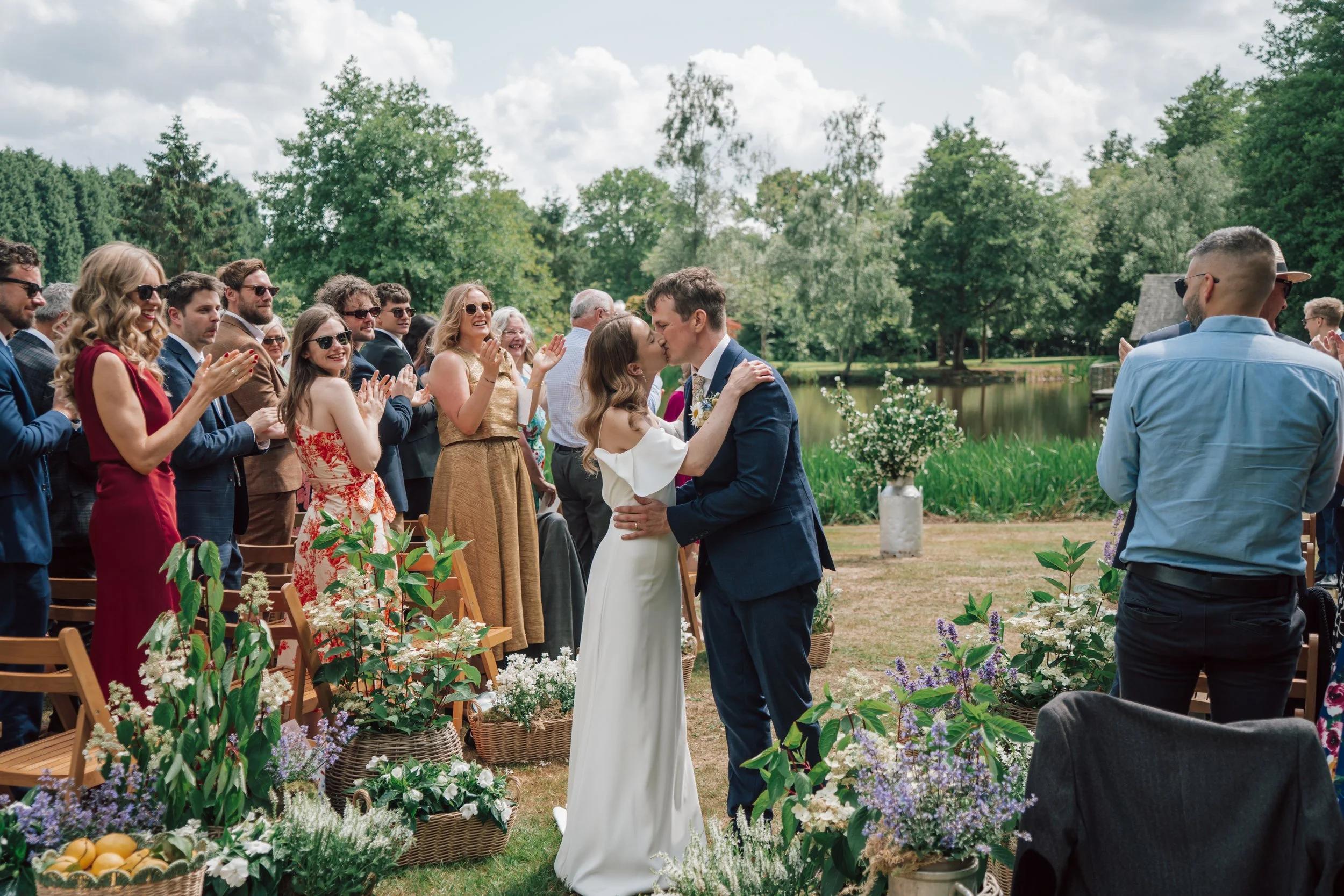
Immediately after the ceremony there is a window of spontaneous joy, congratulations being given, confetti or flowers being thrown, the first moments as a married couple. This typically lasts fifteen to twenty minutes and is some of the most naturally beautiful photography of the day. Do not rush past it to get to the group shots.
Group Photographs
Plan five minutes per group configuration as a minimum. A list of ten groups means fifty minutes. A list of six groups means thirty minutes. Be realistic, every additional group configuration comes at the cost of something else in your timeline. The most efficient approach is a focused, prioritised list of your most important group combinations, completed efficiently, then moving on.
Couple Portrait Session
Thirty minutes minimum. Forty-five to sixty minutes is better. Position this session where the light will be most beautiful, ideally in the late afternoon or during the golden hour window before sunset. If your wedding is in summer, this might mean stepping away from guests around seven or eight in the evening for a golden hour session. That timing is worth planning deliberately.
Reception and Guest Coverage
The reception period benefits from your photographer's presence for the meal, speeches, and key moments. First dance, cake cutting, garden party mingling during summer weddings. A full coverage package typically covers through to the first dance and a portion of the evening. Discuss specifically with your photographer when you want their coverage to end.
Sample Wedding Photography Timeline: Summer Full Day
Here is a practical sample timeline for a typical summer full-day UK wedding with a church ceremony.
Eleven thirty in the morning: Photographer arrives at bride's getting ready location. Hair and makeup in progress, detail shots of dress, shoes, rings, and accessories.
One o'clock in the afternoon: Getting ready images with family and wedding party. Final preparations.
One thirty: Photographer moves to church to capture groom's arrival and guest arrivals.
Two o'clock: Ceremony begins. Photographer covers the full ceremony.
Two forty-five: Ceremony ends. Post-ceremony moments, confetti, informal congregation photographs.
Three o'clock: Group photograph session at the church.
Three forty-five: Travel to reception venue.
Four o'clock: Guests arrive and garden party begins. Couple photographs in venue grounds, canapés, informal guest coverage.
Five o'clock: Wedding breakfast begins. Speeches and meal coverage.
Seven thirty: Couple golden hour portrait session while guests move to evening reception.
Eight fifteen: First dance and evening reception coverage.
Nine o'clock: Photographer coverage ends.
Sample Wedding Photography Timeline: Intimate Winter Wedding
Winter weddings require careful timeline management because the light window is shorter. Here is a sample for a December intimate wedding.
Ten o'clock in the morning: Photographer arrives. Getting ready coverage including detail shots.
Eleven thirty: Ready. Travel to registry office.
Twelve o'clock: Civil ceremony. Short and intimate.
Twelve thirty: Post-ceremony moments. Small group of guests.
One o'clock: Travel to reception venue. Brief outdoor portrait session using available midday light (better in winter than in summer for colour quality, though duration is limited).
One thirty: Reception lunch. Speeches, toasts, intimate moments with close family and friends.
Three thirty: Late afternoon light portrait session outdoors if conditions allow.
Four thirty: Evening continues. Cake cutting, informal photographs by firelight.
Five thirty: Photography coverage ends.
How to Handle the Golden Hour in Your Timeline
The golden hour is the single most valuable light window in a wedding day for outdoor portrait photography. Planning your timeline around it deliberately rather than hoping it coincidentally lines up with a convenient moment, is one of the most impactful decisions you can make.
Find out what time sunset is on your wedding date. Your golden hour window starts approximately one hour before that. Build a thirty to forty-five minute block into your timeline in that window specifically for couple portraits. Communicate this to your venue and your guests so stepping away does not feel unexpected or disruptive.
In July and August in the UK, golden hour typically falls between seven thirty and nine thirty in the evening which works beautifully with an evening wedding timeline. In April and October, it might be four thirty to six. In December, you may be looking at three to four in the afternoon. Know your date, find your window.
Building Buffer Time Into Your Timeline
This is one of the most practically important pieces of advice in this guide: build buffer time into every major transition in your wedding day timeline.
Not because you are disorganised. Not because your suppliers are unreliable. But because weddings are human events, and human events naturally take slightly longer than planned. Hair and makeup runs fifteen minutes over. A family member is late for the ceremony. The coach takes slightly longer than estimated to reach the reception venue.
If your timeline has no slack, every delay compounds the next one and by the time you reach your portrait session you are half an hour behind schedule. If your timeline has fifteen-minute buffers at key transitions, most normal delays are absorbed without affecting the day.
Build buffer time after getting ready before leaving for the ceremony. Build buffer time after the ceremony before starting group photographs. Build buffer time before your couple portrait session. These three buffers alone will protect your day from the majority of common delays.
Communicating Your Timeline to All Suppliers
Your wedding photography timeline is only useful if all of your relevant suppliers are working from the same version of it. Your photographer, your venue coordinator, your hair and makeup team, your transport provider, your caterer, your florist if they are delivering on the day, all of them need to know the timeline and their own role within it.
A simple shared document or a summary email to all suppliers a week before the wedding, confirming the key timings for each, prevents the most common coordination failures. It also gives each supplier an opportunity to flag anything that might affect their element of the day.
How Far in Advance to Share Your Timeline with Your Photographer
Share a draft timeline with your photographer as soon as you have one, even if it is months in advance. The earlier they can review it, the more time there is for thoughtful adjustments. A good photographer will spot timing issues that you might not notice: a portrait session positioned in harsh afternoon sun, group photographs scheduled immediately before the meal when guests will be getting hungry and restless, a timeline with no buffer that leaves no room for normal delays.
Aim to have a final, confirmed timeline agreed with your photographer at least four to six weeks before the wedding. This gives enough time to make any final adjustments and for your photographer to plan their own day accordingly.
Casartelli Photography and Timeline Planning
Every couple who books with Casartelli Photography receives a dedicated pre-wedding planning call to work through the day timeline in detail. This is not a box-ticking exercise, it is a genuine conversation about your day, your priorities, and how to structure your photography coverage to serve both.
If you are planning a wedding across Essex, London, or the wider UK and want photography that is thoughtfully planned rather than just showing up on the day, visit casartelliphotography.co.uk to explore availability and get in touch.
Joey Casartelli is a wedding photographer based in Essex covering London, the South East, and the wider UK. Visit casartelliphotography.co.uk to enquire about your date.